
Barbed Wire Fence Installation
For commercial and industrial properties that need a stronger deterrent than a standard fence line, AMR installs barbed wire fencing across Morris, Hunterdon, Somerset, and Warren County — typically added to the top of an existing or new chain link perimeter. It’s a straightforward, cost-effective way to raise a property’s security level without moving to a full high-security fencing system.
What AMR Builds
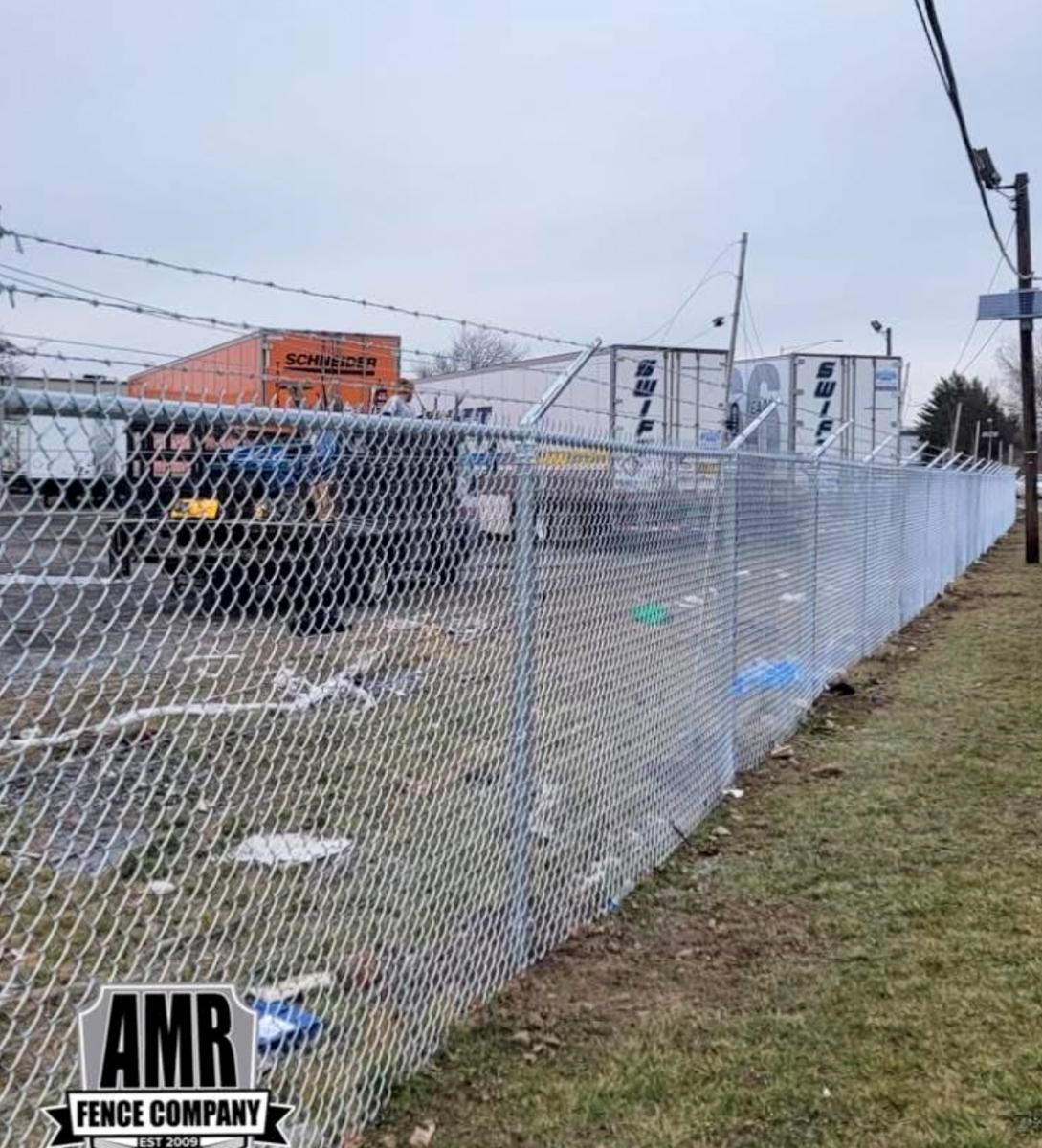
Barbed wire is most often installed on top of chain link fencing to add a physical deterrent along the top of the fence line, common on industrial sites, storage yards, and properties with higher security needs. AMR installs it as part of a full perimeter project or as an addition to existing chain link fencing already in place.

Types of Barbed Wire Installations
Not every property needs the same configuration. A few common setups:
- Single-strand top wire — one line of barbed wire along the top of the fence, the most common configuration for standard commercial perimeter security.
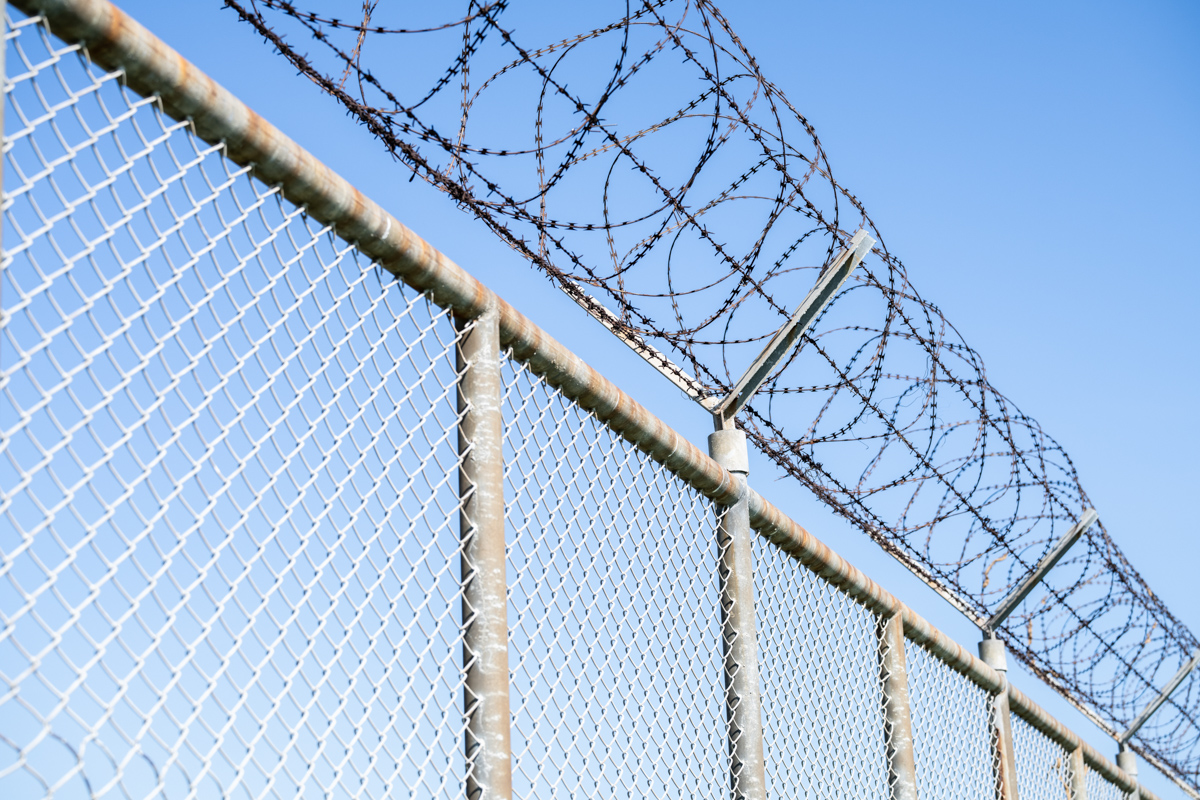
- Angle-arm brackets — arms that extend outward or inward from the top of the fence post, holding multiple strands at an angle for a stronger deterrent. Common on higher-security sites.
- Straight vertical extensions — additional posts extending straight up from the existing fence line with wire strung between them, used where an angled configuration isn’t practical.
Your estimator will walk through which setup makes sense based on the property, what’s being protected, and local code requirements.
Angle-Arm Direction: Inward vs. Outward
For angle-arm configurations, the direction the arm faces matters. An outward-facing arm is the standard choice for keeping intruders from climbing over from outside the property. An inward-facing arm is sometimes used instead — commonly for containment purposes, such as correctional or restricted-access facilities where the concern is people getting out rather than in. Your estimator will confirm which direction fits your property’s actual use case.
Wire Gauge and Material
Barbed wire itself isn’t one-size-fits-all either. Most commercial installations use galvanized steel wire for corrosion resistance, which matters over years of New Jersey weather exposure. Heavier-gauge wire holds up better on higher-traffic perimeter sections or properties with a documented history of attempted breaches, while standard-gauge wire is sufficient for most storage yard and industrial applications. Your estimator can recommend the right gauge based on what the property actually needs rather than defaulting to a single option across every job.
Barbed Wire and Local Code Compliance
Because barbed wire sits at the intersection of security and public safety, most New Jersey townships regulate it to some degree. A few things that commonly come up:
- Minimum mounting height. Many municipalities require barbed wire to start at a minimum height above ground level, often six feet or higher.
- Zoning restrictions. Some residential-adjacent zones restrict or prohibit barbed wire entirely, even on a commercial parcel.
- Signage requirements. Certain townships require posted warning signage where barbed wire is installed.
- Setback rules. Barbed wire may need to be set back a specific distance from a public sidewalk or right-of-way.
None of this is a reason to skip barbed wire where it’s genuinely needed — it just means the configuration has to be planned correctly from the start. AMR confirms what applies to your specific township as part of the on-site estimate, rather than leaving you to research it yourself.
Where Barbed Wire Fencing Works Best
Barbed wire isn’t a fit for every commercial property, but it’s a common and effective addition for:
- Storage yards holding equipment, vehicles, or materials with real resale value
- Industrial sites where perimeter security is a standard operating requirement, not an afterthought
- Utility and substation properties, where restricted access is often a regulatory expectation rather than a preference
- Construction sites with expensive materials or equipment left on-site overnight
- Agricultural and rural commercial properties where deterring both people and larger animals matters
If your property doesn’t fall into one of these categories, a standard chain link or ornamental commercial fence may be a better starting point — see our commercial security fencing page for the full range of options AMR builds.
Why It Matters
For certain properties — storage yards, industrial sites, anywhere with real security concerns — a standard fence line isn’t enough on its own. Barbed wire adds a layer that makes a property meaningfully harder to breach, and it does it without the cost of a full high-security fencing system.
Placement and height matter here more than on most fencing projects. Barbed wire that’s installed too low, at the wrong angle, or without proper anchoring can create liability issues instead of solving them. That’s part of why this is a job for a crew that installs it regularly, not an add-on task handled by whoever’s available.
Common Installation Mistakes
A few issues AMR regularly sees on properties where barbed wire was added as an afterthought rather than planned into the project:
- Insufficient post strength. Existing posts built for chain link alone aren’t always rated to handle the added tension and leverage of angle-arm brackets.
- Inconsistent wire tension. Loose sections sag over time and lose most of their deterrent value.
- Wrong height for the application. Local code and practical deterrent value both depend on getting the top height right for the specific property and use case.
- Poor anchoring at corners and gates. These are the points under the most stress, and they’re the most common place for a weak installation to fail first.
Our Process
AMR runs a straightforward process for barbed wire projects, whether it’s a standalone addition or part of a larger commercial fencing job:
- Estimate request. Tell AMR about your property and security needs.
- On-site estimate. AMR assesses the existing or planned fence line and confirms a firm quote, including which configuration fits the property.
- Contract and scheduling. Commercial timelines are set realistically up front.
- Installation. The in-house crew installs the barbed wire correctly along the fence line, with proper anchoring and consistent spacing.
What Affects Your Barbed Wire Installation Cost
A few factors tend to drive the price on most barbed wire projects:
- Total perimeter length. More linear footage means more material, brackets, and labor.
- Configuration type. Single-strand setups are generally more economical than angle-arm brackets, which require additional hardware and installation time.
- Existing fence condition. Adding barbed wire to an existing chain link fence sometimes requires post reinforcement first, depending on age and condition.
- Number of gates and corners. These points require extra anchoring and attention regardless of the overall configuration chosen.
- Site access. Difficult-to-reach perimeter sections can add time to the installation.
As with any AMR project, your estimator gives you a firm number after walking the property, not a rough estimate over the phone.
Maintaining a Barbed Wire Perimeter
Barbed wire holds up well over time, but a periodic check keeps it functioning as intended:
- Inspect wire tension seasonally. Temperature swings can cause slight loosening over a full year.
- Check for corrosion at connection points. This is usually the first place wear shows up, especially on older installations.
- Confirm brackets remain securely anchored. A bracket that’s started to shift reduces the deterrent value of everything strung from it.
- Clear vegetation growth along the fence line. Overgrowth can hide damage and, in some cases, provide a foothold over the barrier.
Why AMR Fence for Barbed Wire Fencing
AMR handles this work as part of its broader commercial fencing capability — see our commercial security fencing page for the full range of options. The crew is trained in-house, never subcontracted. Because AMR doesn’t sub this kind of work out, the same crew that assesses the property is the one that installs it — which matters for a fencing type where placement and anchoring quality directly affect how well it actually functions.
FAQs
In many cases, yes. Ask your estimator during your on-site visit to confirm whether your existing fence line and posts can support it.
Yes — it’s a standard addition for storage yards, industrial sites, and properties with elevated security needs.
Yes, it can be included as part of a new chain link or perimeter fencing project from the start, which is often more cost-effective than adding it later.
Requirements vary by township and by whether the property is commercial, industrial, or residential. Ask your estimator to confirm what applies to your specific property.
Timelines depend on the total perimeter length and configuration, but most projects are completed within a few days once materials are on-site. Your estimator will give you a specific timeline during scheduling.
Yes — it can be adjusted, extended, or removed as your property’s needs change. This is worth mentioning during your estimate if you anticipate future changes to the site.